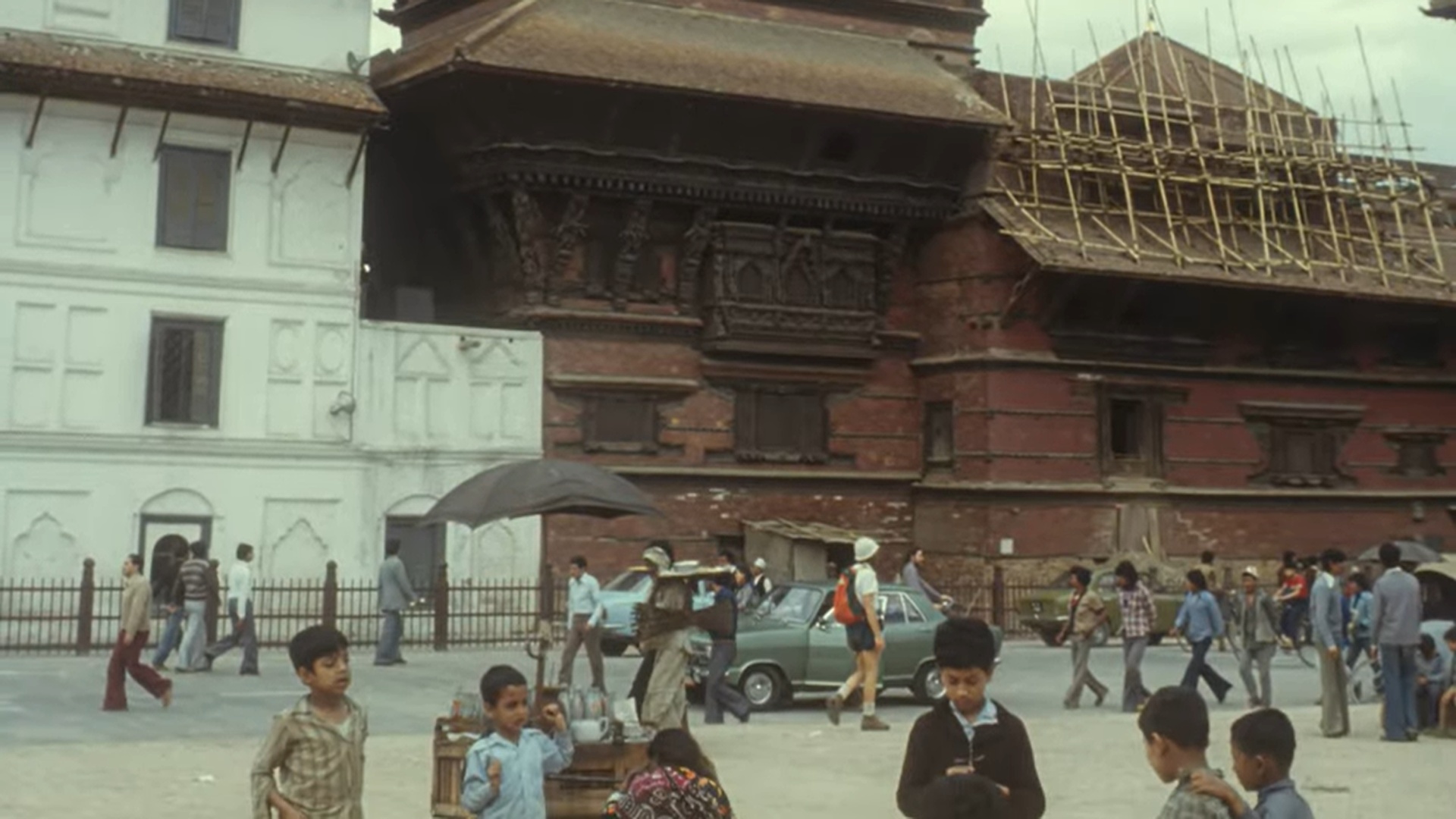
In November 1981, I flew from Bangkok to Kathmandu. Seated next to me on the plane was a Canadian named Randy. He was from Vancouver. Neither of us had been to Nepal before. We were equally naive and excited. We agreed to be travel partners. When we deplaned into the chaos of Kathmandu, we had to fend for ourselves from the first. I was glad to have someone to watch my pack while I went to the loo.
Those were the good old days of travel in Nepal. Nepal’s tourism industry hadn’t taken off yet. Kathmandu was a hideout for hippies seeking off-the-beaten-path adventures. There were no hotels, guides or trekking tours advertised on the Internet. There was no Internet. Inns and hostels were found by word of mouth. There were more animals in the streets than cars. The temples smelled of incense, flowers and rotting fruit. The sidewalks reeked of manure and hashish. Neither Randy nor I had any plans or reservations. Randy had heard that the Annapurna Loop was a good trek. So, we made this our plan.
Traveling light as usual, I had none of the equipment that I’d need for a trek in the Himalayas. No problem. Kathmandu is an excellent place to rent trekking equipment thanks to customs regulations. At that time, Nepal allowed mountaineers to enter the country with as much equipment as they needed. However, there were severe limits on how much gear and equipment foreigners could return home with. International mountaineering expeditions were often forced to jettison their trekking gear, or give it to their Sherpas in payment for guide services. This enabled Sherpa families to open shops in Kathmandu where they rented mountaineering equipment. For a few dollars, I rented everything I needed: A down jacket, a sleeping bag and a pack left behind by a Polish expedition to Mount Everest. This gear would keep me warm and toasty on my Annapurna trek.
Before leaving Kathmandu, I took care of one final transaction. I cashed $100 worth of Traveler’s cheques into rupees. The bank teller wasn’t used to dealing with such a large sum of money – and I was too inexperienced to request small bills. I left the bank with some small change and a 1,000 rupee note in my wallet.
The next part of our plan required getting to Pokhara in western Nepal, a distance of about 200 kilometers from Kathmandu. We were apprehensive about our first bus ride in southern Asia. Randy and I boarded early to claim our two “reserved” seats. As the remaining 60 or 70 passengers squeezed into the bus, we realized that our two seats were intended for four people. Luckily, we only had to share our seats with one other passenger ... and her chickens and children. I watched as luggage and packages were thrown onto the roof and lashed there. After a couple dozen men made themselves comfortable on the roof of the bus, we were ready to depart.
The bus ride was long and bumpy. The mountain road had lots of hairpin turns. As we swung around tight corners, the suspension groaned. I was glad to have a window seat. The views were breathtaking and nerve-wracking. With an equal number of left and right turns, I reasoned that I had a fifty-fifty chance of escaping through the window if, on one of the hairpin turns, our top-heavy bus toppled over onto its side – provided the bus didn’t fall off a cliff.
The children sitting with us were fascinated by our packs. They acted as though they’d never seen zippers or Velcro. Zip open, zip close, zip open, zip close, zip open. Little hands were curious about what was inside our packs. My red and blue hiking socks tumbled out. At that point, I zipped my pack firmly shut and handed a sock to Randy. On cue, Randy and I slipped the socks over our hands to make sock puppets. For the next two hours, we entertained the children with the adventures of Hawkeye and Radar. This helped pass the time and made me stop worrying about our bus falling off a cliff.
By late afternoon, we arrived in Pokhara tired, shaken, but uninjured. There we dealt with the bureaucratic challenge of getting our trekking permits. Although it was Sunday evening, the permit office was open. How convenient to be in a Buddhist country, where government offices are open on Sundays – provided it’s not a Buddhist holiday.
On Monday, the first day of our trek, Randy and I hiked four hours to a village called Naudanda. It was a gentle uphill stroll. By this time, I was getting used to Nepal, the people, their way of life, and their curried dal bhat (lentils and rice). As for Randy, he wasn’t happy with the food. He was growing impatient with the Nepalese. He wanted to see Annapurna as soon as possible. Although I was concerned that our travel partnership would have problems, I needn’t have worried. After lunch, Randy picked up his pack and marched out of town. I found a nice place to spend the night in Naudanda. We never saw each other again.
This brief travel partnership was a lesson learned. Travel is a fluid process. When you find someone going your way, it’s natural to fall into step with someone else. If later you and your partner have different ideas of where to go next, it’s equally natural to say goodbye and never see each other again. The way that short-term travel relationships can develop and then disappear is refreshing. In all my travels, I’ve never begun an extended international journey with anyone. My best travel partners have been people I’ve met along the way.
On Tuesday, a troop of Nepalese packers overtook me on the path. They were carrying huge bags of apples up into the mountains. The bags strapped onto their backs must’ve weighed forty kilograms, yet they passed me as if I were standing still. They were hiking without shoes. Six days later, this same troop of barefoot packers came back down the trail carrying refrigerators on their backs. They were returning from the Chinese border. With my hiking boots, my modest pack and at my unhurried pace, it would take me ten days to do half of what they did in six.
As I continued up into the breathtaking Himalayas, I found hospitable villages along the trail. Around mid-day, women would put bowls on tables in front of their homes as an invitation for lunch. Late afternoons, children greeted me and took me by the hand to show me their family’s homestay. I ate my dinners indoors, sitting with families around an open fire. I slept on straw mats on the floor, glad to have the comfort of my well-padded Polish sleeping bag. In the mornings, the children showed me where to wash up at the nearby spring. After breakfast, they would follow me to the edge of their village hoping to get a sweet from the bag of candy hidden in my pack.
For the first few days, I had sufficient small bills to pay for my food and lodging. But eventually, the only money left in my wallet was the 1,000 rupee note from the Bank of Kathmandu. One morning, I produced my 1,000 rupee note to pay my host for my overnight in his home. There was a gasp of amazement from everyone present. They’d never seen such a large bill – or even known that one existed. My host reverently asked if he could touch it. Then, he invited his neighbors into his house to see my 1,000 rupee note. Soon, the whole village came running to see this wondrous sight.
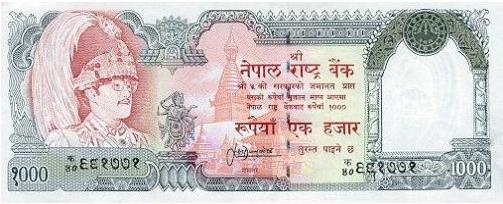
For the next few days until I reached the Chinese border, I found no one who could change my money. I bartered my pens, pencils, candy, postcards, spare shoe laces and Eveready batteries for lodging. Sometimes, I received free food and drink in exchange for exhibiting my 1,000 rupee note. It was an awkward yet comical situation, much like Mark Twain’s comedy The Million Pound Bank Note.
By the time I reached Jomsom at the Chinese border, news of my 1,000 rupee note had preceded me. The innkeeper in Jomsom, assuming that I’d be staying at his place for a few days, dining at his table and drinking at his bar, was prepared for my arrival. He had canvassed the local community and collected 900 rupees. When I checked in at his establishment, I received 900 rupees in small bills and a 100 rupee credit good for lodging, food and drink. I had only to spend 100 rupees for a private room, dal bhat and Raksi. The innkeeper became the proud owner of the 1,000 rupee note, which many people – i.e. customers – flocked to his inn to see.
In Jomsom, I reached an impasse. The border from Nepal into China was closed to foreigners which meant that continuing north was not an option. From Jomsom, the Annapurna Loop trail climbs east over the Thorung La pass, elevation 5,416 meters. Winter was coming. Although the pass wasn’t yet closed, it was due to close soon – at any minute. My only alternative was to hike back down the same long valley that I’d just hiked up. Although it had been a scenic trek, I didn’t want to retrace my steps.
I suspected there might be one more option. Hiking into Jomsom, I’d noticed the logo of the Royal Nepalese Airlines stenciled onto a whitewashed building next to a gravel landing strip. I asked my innkeeper if there was air service out of Jomsom. He laughed and said “Too much wind. Plane can’t land.” I persisted and asked if there was a flight schedule. The innkeeper pointed to a gentleman reading by the fire and said “Ask him.”
The gentleman reading by the fire was Mr. Datta Tary Roy, Jomsom’s representative and ticket seller for the Royal Nepalese Airlines. Mr. Roy was as pessimistic about flights in and out of Jomsom as the innkeeper had been. No planes had landed for two weeks due to high winds. Although there might be a break in the weather in the next few days, all seats were sold to a Korean mountaineering expedition. If a second or a third flight got into Jomsom after that, those seats were already sold, too.
I bought Mr. Roy a glass of Raksi and we continued chatting. The fire and the alcohol kept us warm. Conversation flowed. Mr. Roy was an avid cribbage player. I told Mr. Roy I might enjoy a game or two with him. I didn’t tell Mr. Roy that I’d been playing cribbage since I was six. Mr. Roy placed his cribbage board and a well-used deck of cards on the table between us. We started playing.
Knowing I had 900 rupees in my pocket, Mr. Roy bought a round of drinks and suggested that we play for money. I agreed and began to lose. I won an occasional game, but made sure that Mr. Roy won four games out of five. I lost 300 rupees. As the fire burned low and everyone else had long ago gone to sleep. I offered a final wager: My remaining 600 rupees (about $50) versus a plane ticket from Jomsom to Pokhara on the next flight. Mr. Roy readily agreed. I played our last match the way my father taught me to play and I skunked him.
The next day, dawn broke with blue skies and no wind. Mr. Roy met me at breakfast. He made good on our bet and handed me a ticket. He had only to tell the Koreans that 75 kilograms of their climbing equipment would be sent on a later flight. Mr. Roy asked me one favor. He admired my Canon AE-1. He asked if I would take his photo with his plane in the background, and mail it to him. This was an easy favor to grant. After our coffee, Mr. Roy escorted me out to the runway. As the plane landed, I snapped a shot of Mr. Roy with his plane and Annapurna in the background. Two weeks later when I was in Melbourne, I had the photo printed and enlarged to an 8x11 glossy, and mailed it to him.
My flight out of Jomsom was unforgettable. Because the airstrip was deep in the Kali Gandaki River gorge, surrounded by peaks like Annapurna (8,091 m), it’s difficult for a plane to get out of this valley. We took off going north towards China. The plane spiraled upwards to gain altitude. We circled perhaps a dozen times until we could see over the high ridges that surround Jomsom.
The pilot then pointed us south, gunned his engines, and headed for the shoulder of Annapurna. From my window seat, I watched anxiously as we approached the ice field. From where I sat, it looked like we were going to land – or crash! – on the glacier. But the pilot knew his route well. A few meters before the icy ridge, a warm updraft from the Indian lowlands lifted the plane over Annapurna’s shoulder. The prop wash from the propellers stirred up the snow beneath us, blowing a sparkling white plume behind us. As we crossed the ridge, Annapurna’s magnificent peak seemed close enough to touch. Once over Annapurna’s shoulder, the ground beneath us dropped away to Nepal’s lowlands 6,000 meters below. My heart was in my throat.
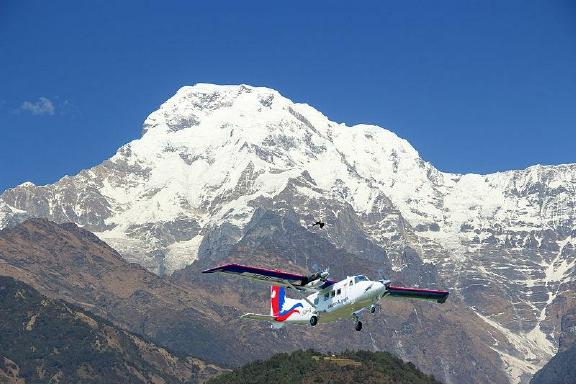
The pilot eased back on the throttle and we glided down to Pokhara. Although there’d been a few moments of concern, I enjoyed this flight so much I took another Royal Nepalese Airlines flight from Pokhara back to Kathmandu a week later. This saved me from spending a full day crowded onto a bus full of children and animals. Sometimes the view from an airplane window gives you a chance to see something you might not see from the ground.
Much has changed in the decades since my 120-km trek up the Kali Gandaki valley. It’s now possible to drive from Pohkara to Jomsom on a mostly paved road. Jomsom even has a bus terminal. Tourists who come here book their treks online with a tour company, follow a guide, and stay in lodges with beds, electricity and indoor plumbing. The Jomsom airport (IATA code: JMO) has a paved runway and offers daily flights to Pohkara. Adjacent to the airport are ten hotels, four banks, two shopping arcades and a German bakery. One thing that hasn’t changed is that weather and terrain still make flying out of Jomsom risky. In the past ten years, there have been three plane crashes and 38 fatalities.